


MAYA CALENDAR CONVERTER
Any date in the Gregorian calendar can be converted into a corresponding one in the Maya calendar system. A particular day, month, and year can be expressed as a Long Count date using baktun, katun, tun, uinal, and k'in units of time together with a Haab and a Tzolk'in calendar date.
Find the meaning of each day in the Tzolk'in calendar system (PDF)
Instructions: Select month, enter day and year, then click CONVERT
Supports 3000 BCE – 4000 CE. Use negative year for BCE (e.g. −2360).
April 13, 2026



Long Count Date
13.0.13.9.1
"Each day in the sacred Maya calendar has a meaning. It tells us about the relationship among all things, including the animals, the land, humans, and everything in the cosmos."
Reading the Maya Calendar
The Maya calendar system records a series of recurring cycles of time based on the movements of the Sun, Moon, and planets. Any given date repeats at cyclic intervals, just as, for example, January 1st in the Gregorian calendar repeats every time the Earth completes a revolution around the Sun. A complete Maya Long Count cycle is 5,125 years long. The Maya Long Count system establishes an absolute chronology in which any given date is unique, such as December 21, 2012, in the Gregorian system. The Long Count calendar keeps track of the days that have passed since the mythical starting date of the Maya creation, August 11, 3114 BCE.
The basic unit of time is the day, or k'in.
◆ 20 k'in = 1 uinal or 20 days
◆ 18 uinal = 1 tun or 360 days
◆ 20 tun = 1 katun or 7,200 days
◆ 20 katun = 1 baktun or 144,000 days
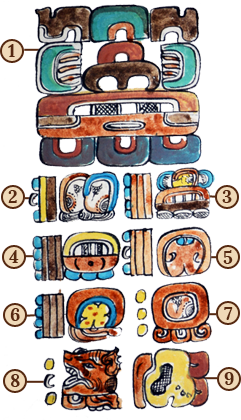
The Long Count date is written in column format as shown in the example on the right, with cycles of time as follows: 12.19.19.17.19 | 3 Kawak | 2 K'ank'in | G8 This date corresponds to December 20th, 2012 in the Gregorian calendar, and is read as follows: baktun.katun.tun.uinal.k'in | Tzolk'in | Haab | Lord of the Night
1Initial Series Introductory Glyph: This symbol identifies this date as belonging to the Long Count system.
2Baktun: A number (12 in this example) along with the symbol of "baktun".
3Katun: A number (19 in this example) along with the symbol for "katun".
4Tun: A number (19 in this example) along with the symbol for "tun".
5Uinal: A number (17 in this example) along with the symbol for "uinal".
6K'in: A number (19 in this example) along with the symbol for "k'in".
7Tzolk'in date: A number (3 in this example) along with the Tzolk'in day glyph (Kawak in this example).
8Haab' date: A number (2 in this example) along with the Haab day glyph (K'ank'in in this example).
9Lord of the Night: (G8 in this example): A glyph that represents one of the nine deities of the Maya Underworld.